
In Belvedere Park, GA, summer heat is no joke, and from the humidity that settles over neighborhoods near Glenwood Road to the brutal afternoon temperatures pressing down on homes along Flat Shoals Parkway, residential AC systems take a serious beating once the season peaks. In our service calls throughout Belvedere Park, we see the same patterns recur, and the reasons behind that struggle are rarely a mystery to an experienced technician. Most of the time, it comes down to a handful of well-known factors, and understanding them helps homeowners make smarter decisions about their equipment. If your home has been warmer than it should be this summer, our air conditioning services team in Belvedere Park has compiled what we typically find when we get on-site.
1. Inadequate Maintenance: Why Regular Check-Ups Matter
Routine maintenance is the single most important factor in keeping an AC system performing during extreme heat. Without it, small issues quietly compound until the system simply cannot keep up on the hottest days of the year.
During a professional AC maintenance visit, a trained technician does far more than a quick visual inspection. A thorough check-up typically covers:
- Refrigerant level verification: Confirming the system has the correct charge for peak cooling capacity
- Coil cleaning: Removing the buildup of dirt and debris that insulates coils and reduces heat transfer
- Filter replacement: Ensuring unrestricted airflow through the air handler
- Electrical connections: Checking and tightening connections that can loosen over time and cause intermittent failures
- System calibration: Confirming that the unit cycles properly and shuts off at the right point
Skipping annual maintenance does not just reduce efficiency in the short term. It accelerates wear on expensive-to-replace components and leaves the system vulnerable to failure exactly when demand is highest. Working in homes across Belvedere Park, we often find that the systems struggling hardest in July are the ones that have not seen a technician since installation.
2. Aging Equipment: When It Is Time for an Upgrade
Every AC system has a finite lifespan, and as units age past the ten- to fifteen-year mark, they become progressively less capable of handling extreme heat. The components that manage compression and heat exchange degrade over time, and efficiency ratings that looked solid a decade ago simply do not hold up under modern summer conditions.
Signs of Inefficiency
The early signs that a system is aging out are easy to overlook until the heat forces the issue. Based on what we see in Belvedere Park properties, the most common signals include:
- Uneven cooling across rooms, with some spaces remaining noticeably warmer than others
- Unusual sounds during operation, such as rattling, grinding, or persistent clicking
- Persistent odors that suggest mold growth or electrical issues inside the unit
- A rising frequency of service calls over the past two to three years
When repair visits become a recurring event rather than a rare exception, the conversation about replacement warrants serious consideration.
Energy Consumption Increases
An aging system that is losing efficiency not only cools less effectively but also uses more electricity. When a unit runs longer cycles to reach the set temperature, the utility bill reflects the extra runtime.
Homeowners in Belvedere Park sometimes assume rising summer bills are simply the cost of the season. Often, they are actually a signal that the system is working significantly harder than it should be to deliver the same output it once achieved with less effort.
Maintenance Costs Rising
There is a practical threshold at which continued investment in an aging system ceases to make financial sense. When the combined cost of recent repairs approaches or exceeds the energy savings and reliability a new system would deliver, replacement is typically the more economical path forward.
Newer equipment not only operates more efficiently but also carries manufacturer warranties that reduce exposure to unexpected repair costs. Our team helps homeowners evaluate that crossover point with straightforward, honest information rather than pressure to act in either direction.
3. Blocked Airflow: How Obstructions Impact Performance
Restricted airflow is one of the most common and most preventable reasons an AC system struggles in the heat. When air cannot move freely through the system, cooling capacity drops, runtime increases, and components wear faster.
Obstructions can originate at multiple points in the system:
- Clogged air filters: A filter that has not been changed on schedule restricts the volume of air moving through the air handler, forcing the blower to work harder while delivering less
- Blocked return vents: Furniture, rugs, or stored items placed against return air grilles reduce the system’s ability to draw warm air back for cooling.
- Dirty evaporator coils: When airflow is restricted over time, coils collect debris and lose their ability to absorb heat efficiently
- Outdoor unit clearance: The condenser needs open space around it to release heat; vegetation, fencing, or debris stacked nearby can choke performance
Our AC and furnace air filter replacement service addresses one of the most overlooked contributors to airflow problems. A clean, properly rated filter is a small detail that has a measurable effect on system performance, particularly during periods of heavy demand.
4. Refrigerant Issues: Understanding Low Levels and Leaks
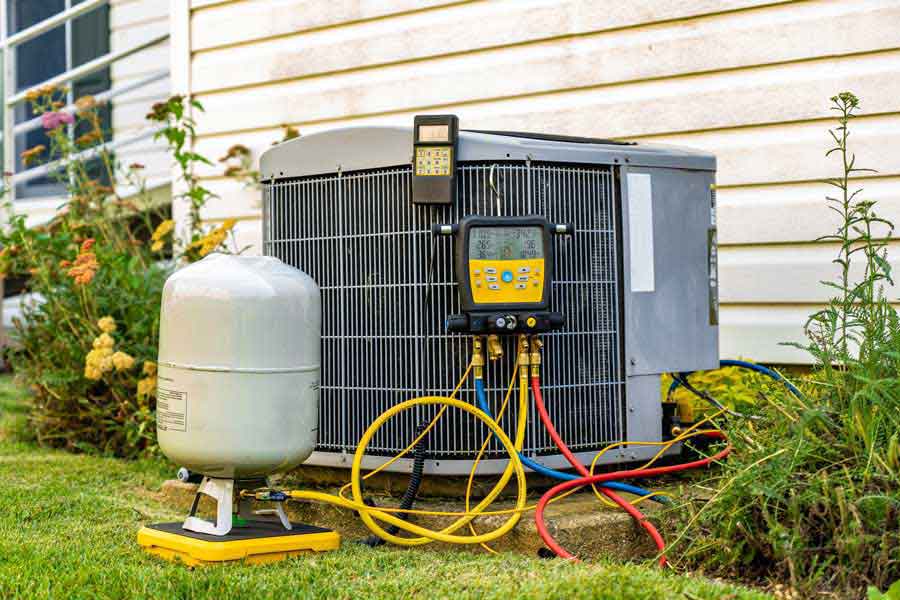
Refrigerant is the working fluid that enables cooling. When the level is low or a leak is present, the system loses its ability to absorb heat from indoor air and reject it to the outdoors. The result is a unit that runs continuously but never brings the temperature down to the required level.
Low refrigerant is not a consumable that depletes through normal use. When levels are off, it almost always means there is a leak somewhere in the system. Common indicators include:
- The home never reaches the thermostat set point during peak afternoon hours
- Ice forming on the refrigerant lines or evaporator coil
- A hissing or bubbling sound near the air handler or outdoor unit
- Noticeably longer run cycles than the system used to require
Refrigerant leaks need to be located and repaired before recharging the system. Simply adding refrigerant without addressing the source of the loss is a temporary measure that does not solve the underlying problem. Our technicians carry the tools and certifications to accurately diagnose refrigerant issues and handle them properly in accordance with EPA guidelines.
5. Thermostat Problems: Is Your AC Getting the Right Signals?
A thermostat that misreads conditions or sends incorrect signals can undermine an otherwise healthy system. If the thermostat believes the home is cooler than it actually is, it will not call for cooling often enough. If the system is cycling erratically, the equipment cannot sustain the cycles needed to pull down both temperature and humidity.
Common thermostat-related issues we find in Belvedere Park homes include:
- Poor placement: Thermostats installed near windows, kitchen appliances, or exterior walls can read artificially high or low temperatures that do not reflect actual living space conditions
- Low or failing batteries: Intermittent power issues cause erratic behavior that is often mistaken for a larger system problem
- Outdated equipment: Older mechanical thermostats lack the precision and responsiveness of modern digital and smart controls
- Calibration drift: Thermostats can fall out of calibration over time, reading several degrees off from actual room temperature
Professional thermostat repair and installation is often one of the most straightforward fixes when a system behaves inconsistently. Modern smart thermostats can adapt to usage patterns, respond to real-time conditions, and give homeowners far greater visibility into how their equipment is actually performing day to day.
6. Ductwork Deficiencies: The Hidden Culprit of Inefficiency
The duct system distributes conditioned air to every room in the home. When ducts are leaking, poorly insulated, or partially blocked, a significant portion of the cooling the system produces fails to reach its intended destination. In our experience working across Belvedere Park and the surrounding DeKalb County neighborhoods, homeowners consistently underestimate duct-related losses.
Key ductwork problems that reduce system performance include:
- Leaks and gaps at connections: Conditioned air escaping into unconditioned attic or crawl space before it reaches the living area represents direct energy waste and reduced comfort
- Inadequate insulation: Ducts running through hot attic spaces can absorb significant heat, warming the air before it ever exits a register
- Blockages from debris or collapsed sections: Accumulation inside ducts or physically damaged duct runs restricts airflow and creates uneven distribution throughout the home
- Undersized duct runs: An original duct design that does not match the current system’s airflow requirements will throttle performance, regardless of how well the equipment itself is functioning.
Professional ductwork repair requires proper diagnostic tools to assess effectively. Our team is certified by the National Comfort Institute in system performance and duct design, which means we approach ductwork analysis with precision that goes well beyond a visual inspection alone.
7. Incorrect Sizing: Why Your AC Might Be Too Small or Too Large
Equipment sizing is one of the most consequential decisions in any HVAC installation, and it is also one of the most commonly done incorrectly. A unit that is the wrong size for the home it serves will underperform in ways that no amount of maintenance can fully correct.
The Impact of Oversized Units
An oversized air conditioner cools the home quickly but shuts off before it has run long enough to reduce humidity. The result is a home that feels cold and clammy rather than cool and comfortable, along with a system that short-cycles through repeated start-stop sequences, increasing both wear and energy consumption.
Signs of an oversized unit include:
- Rapid temperature drops followed by quick shutdowns
- Persistent humidity problems even when the thermostat set point is met
- Uneven comfort across rooms despite reaching the target temperature
- Higher-than-expected energy bills despite relatively short run times
The Consequences of Undersized Units
An undersized unit faces the opposite problem. It runs continuously, struggling to keep pace with the home’s heat gain and never reaching the set temperature during peak afternoon hours. This extended runtime increases energy costs, accelerates component wear, and leaves occupants uncomfortable, even though the system never stops running.
Getting sizing right requires a proper Manual J load calculation that accounts for square footage, insulation levels, window area, orientation, local climate data, and several other variables. Guessing based solely on square footage routinely results in oversized or undersized installations. Our team performs full-load calculations before recommending any system, ensuring the equipment we install is truly matched to the home.
Aced It This Summer
Extreme heat in Belvedere Park puts every weak point in an HVAC system to the test. Whether the issue is deferred maintenance, aging equipment, airflow restrictions, refrigerant loss, thermostat problems, duct inefficiency, or a sizing mismatch, each of these factors has a real solution when properly diagnosed by someone who knows what to look for. At Ace & A Heating & Air Conditioning, we are a family-owned company built by technicians who take pride in doing the job right the first time, bringing National Comfort Institute-certified expertise, transparent flat-rate pricing, and a genuine commitment to your comfort across every neighborhood we serve, from the homes along Glenwood Road to the streets near Flat Shoals Parkway. If your system is struggling to keep up, do not wait for a full breakdown. Contact our team today and let us restore your home’s comfort before the next heat wave moves in.