
Energy efficiency and AC performance are more closely connected than most homeowners realize, and in Decatur, GA, where systems run for months at a time during the summer, even modest efficiency improvements translate into meaningful savings on monthly utility bills. From the neighborhoods near East Lake to the homes along Medlock Road, the systems that cost the least to operate are almost always the ones that have been consistently maintained and repaired promptly when issues arise. Our AC repair services are designed around exactly that principle, and this guide covers the practical steps that make the biggest difference.
Understanding the Importance of Energy Efficiency in AC Systems
An air conditioning system’s efficiency rating reflects how much cooling output it delivers per unit of electricity consumed. That ratio matters not just at installation but throughout the system’s service life, because efficiency degrades when components are dirty, worn, or operating outside their design parameters.
A system running with a clogged filter, low refrigerant, or a failing capacitor uses more electricity to deliver the same cooling it once achieved easily. That extra energy consumption shows up on the utility bill before most homeowners notice any change in comfort. The relationship between system condition and operating cost is direct: a well-maintained, properly repaired system costs less to run, and that difference compounds over an entire cooling season.
Upgrading to a higher-SEER system is one path to improved efficiency, but keeping the existing system in good repair is often the more immediate and cost-effective step for homeowners whose equipment is not yet at the end of its service life.
Common Signs Your AC Needs Repair
Recognizing the early warning signs of an AC problem allows homeowners to address issues before they progress into more costly failures and before efficiency losses have time to accumulate on the utility bill.
Signs that a system needs professional attention include:
- Weak or warm airflow from the vents: When the system is running but not moving adequate cool air, the cause is typically a refrigerant issue, a failing blower motor, or severe airflow restriction
- Unusual operating noises: Grinding, banging, hissing, or rattling sounds indicate mechanical wear or a developing component failure that will worsen with continued operation
- Unexplained increases in energy bills: A system that is losing efficiency due to a developing problem will reflect that in higher utility costs before comfort complaints become obvious
- Frequent cycling on and off: Short cycling puts repeated stress on the compressor and prevents the system from completing the full cycle needed to manage both temperature and humidity effectively
- Uneven cooling across rooms: When some areas of the home are noticeably warmer than others despite the system running, it often points to an airflow, refrigerant, or equipment issue rather than a duct or layout problem
Each of these symptoms has an identifiable cause. Addressing them early almost always results in a less expensive repair and prevents the efficiency losses that come with running a degraded system over an extended period.
Maintaining Your AC Unit for Optimal Efficiency
Consistent maintenance is the most reliable way to protect both system efficiency and equipment longevity. The correlation between maintenance history and operating costs is well established: systems that are serviced annually perform more efficiently and require fewer emergency repairs over their service life.
Key maintenance practices that directly affect efficiency include:
- Filter replacement on schedule: A dirty filter is one of the most common causes of reduced airflow and increased energy consumption. Filters should be checked monthly during peak cooling season and replaced when airflow restriction becomes visible. Our AC and furnace air filter replacement service keeps this addressed as part of a broader maintenance visit.
- Outdoor unit clearance: The condenser unit must be able to reject heat freely. Debris, overgrown vegetation, and accumulated dirt on the coil fins all impair that process and force the system to work harder.
- Thermostat calibration and settings: A thermostat that reads inaccurately or is programmed inefficiently causes the system to run unnecessarily. Our thermostat repair and installation service addresses both calibration issues and upgrades to smart controls that manage cooling schedules more precisely.
- Annual professional inspection: A certified technician checks refrigerant levels, cleans coils, inspects electrical connections, and evaluates overall system performance. Catching a developing issue during a scheduled visit prevents both the repair cost and the efficiency loss that comes from running a compromised system.
Choosing Energy-Efficient Replacement Units
When a system reaches the point where repair costs and efficiency losses make replacement the more economical decision, selecting the right replacement unit is what determines how much the new system will cost to operate over its service life.
Key factors in selecting an energy-efficient replacement include:
- SEER rating: The Seasonal Energy Efficiency Ratio reflects how efficiently a system cools over an entire season. A SEER of 14 or higher is the baseline for modern efficient equipment, and systems with ratings in the high 20s and above deliver substantially lower operating costs. As a Fujitsu Elite dealer, Ace & A HVAC, Heating & AC Repair installs systems rated up to 33 SEER.
- Correct sizing: An oversized system short-cycles and fails to control humidity effectively. An undersized system runs continuously without reaching the set temperature. Neither scenario is efficient, and neither can be corrected through settings or maintenance alone. Proper Manual J load calculation is the only reliable path to correct sizing.
- Energy Star certification: Equipment certified under the Energy Star program meets efficiency standards set by the EPA and qualifies for various tax credits and rebates, including those available under the Inflation Reduction Act
- Variable-speed components: Systems with variable-speed compressors and fans modulate their output based on actual demand rather than cycling between full-on and full-off. This reduces energy consumption, improves humidity control, and extends equipment life.
The Role of Professional Services in Energy-Efficient AC Repair
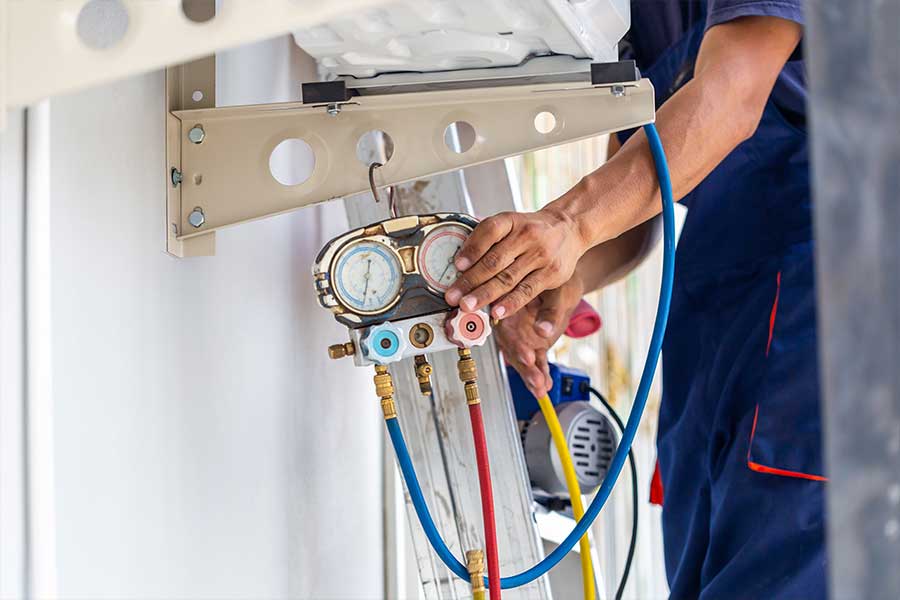
The connection between professional service and energy efficiency is straightforward. A technician who diagnoses the actual cause of a problem and repairs it correctly the first time restores the system to its designed efficiency level. Deferred repairs, partial fixes, or incorrect diagnoses leave the system operating below its potential and continue to generate unnecessary energy costs.
At Ace & A HVAC, Heating & AC Repair, our technicians use accurate diagnostic tools, provide written estimates with transparent flat-rate pricing, and back repair work with real warranties. We work across all major HVAC brands and stay current with the latest equipment and efficiency standards through ongoing training.
Lowering Your Bills Starts with Your AC System’s Condition
A well-maintained, properly repaired AC system is one of the most direct ways to reduce monthly energy costs in a Decatur home. If your system is showing signs of reduced performance or it has been more than a year since its last professional service visit, contact us today so we can get it running at the efficiency level it was designed for.